
If you’ve ever watched a professional match, you may have wondered exactly how many players in football lineups are on the pitch at kick-off. Whether you are brand new to following the beautiful game or looking to settle a quick rules dispute, understanding team structures is critical to enjoying the sport.
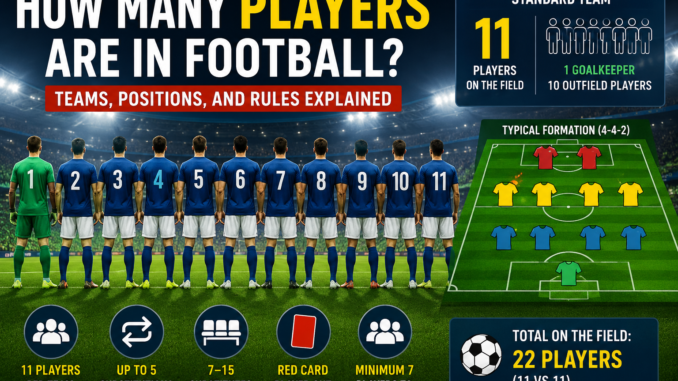
So, exactly how many players are there in a football team? According to the official Laws of the Game governed by the International Football Association Board (IFAB), a standard professional match features exactly 11 active players per team on the pitch at any given time (IFAB, 2025). This creates a total of 22 active players contesting a single game. This starting XI is strictly divided into:
- 1 Goalkeeper: The specialized defensive shot-stopper.
- 10 Outfield Players: Consisting of defenders, midfielders, and forwards.
Modern competition features layers of strategic nuance. To understand comprehensively how many players are there in football altogether, you must look beyond the starting field to analyze how club organizations structure their broader rosters, handle match-day substitutes sitting in the technical dugout, and manage tactical formations under global regulatory frameworks (IFAB, 2025).
The Core Lineup: Roster Rules on the Pitch
A team starts every official, professional match with exactly 11 players on the field, which directly answers the fundamental question of how many players are in football squads during active play (IFAB, 2025). The overall calculation at the start of play means there are 22 active players on the pitch, excluding coaches, substitutes, and match officials.
These 11 active squad positions are divided into distinct tactical areas based on specialized defensive and attacking responsibilities:
| Position Group | Typical Player Count | Core On-Pitch Responsibilities |
| Goalkeeper | 1 | The ultimate line of defense; the only player permitted to handle the ball using hands/arms, strictly within their designated 18-yard penalty area (IFAB, 2025). |
| Defenders | 3 – 5 | Positioned ahead of the goalkeeper to disrupt opposition attacks, block shots, and clear the ball from danger zones. |
| Midfielders | 3 – 5 | Operating in the center of the pitch to control game tempo, link defensive transitions, and engineer goal-scoring opportunities. |
| Forwards | 1 – 3 | The primary attacking line responsible for penetrating opposition lines, creating space, and scoring goals. |
The 11 Football Positions Explained
What Are the 4 Main Positions in Football?
To truly understand how the lineup functions, you have to break down the four foundational pillars of any starting XI: Goalkeepers, Defenders, Midfielders, and Forwards. While the one goalkeeper per team remains a non-negotiable rule (IFAB, 2025), the exact combination of outfield players changes dynamically based on a coach’s tactical strategy.
1. Goalkeeper
A goalkeeper (GK) is a team’s last line of defense. Wearing a unique jersey to stand out from regular outfield players, the goalkeeper anchors the penalty area. They are the only asset on the pitch legally permitted to use their hands to catch or punch the ball, a luxury restricted strictly to their own 18-yard box (IFAB, 2025). If they venture outside this boundary, they must play purely with their feet like any other outfield player.
2. Defenders and Specializations
Defenders form the protective shield in front of the goalkeeper. Their primary duties are to win tackles, execute clean interceptions, and clear lines under heavy offensive pressure. In the modern era, they also initiate building out from the back:
- Centre Backs (CB): Central defenders are physically imposing aerial threats who occupy the absolute middle of the backline to neutralize opposing strikers.
- Full Backs: Operating on the flanks as either a Left Back (LB) or Right Back (RB), these players balance defensive shielding with blistering overlapping runs up the sidelines.
- Wing Backs: Highly offensive full-backs deployed in three- or five-man defensive systems to control the entire wing.
3. Midfielders and the Engine Room
Midfielders dominate the central third of the pitch, acting as the indispensable bridge connecting defense and attack:
- Central Defensive Midfielders (CDM): Tasked with disrupting counter-attacks, breaking play, and shielding the center-backs.
- Central Midfielders (CM): The box-to-box engine drivers who dictate game tempo, distribute short passes, and sustain possession.
- Central Attacking Midfielders (CAM): Creative playmakers operating just behind the forwards, looking to slip a killer final pass through tight spaces.
- Wingers: Wide midfielders (LW/RW) who stretch the opposition by taking on defenders with raw pace, delivering curling crosses, or acting as inverted wingers who cut inside on their dominant foot to unleash shots at goal.
4. Forwards and Strikers
Forwards are positioned closest to the opposition’s goal, carrying the primary burden for team finishing:
- Centre Forward (CF) / Striker: Highly skilled marksmen who use physical strength to hold up play or use spatial awareness to break away into the box.
- The False 9: A deep-lying creative forward who intentionally drops away from the opposition backline into midfield. This tactical move pulls central defenders out of position, opening massive passing lanes for oncoming wingers.
Must Read: Messi Net Worth in Rupees
Popular Formations in Modern Football
While the starting lineup framework remains static at 11, the structural layout changes depending on a manager’s tactical strategy. Formations are noted by three or four numbers representing defenders, midfielders, and attackers (excluding the goalkeeper):
- 4-4-2: Balanced structure featuring two traditional central strikers.
- 4-3-3: An attacking framework utilizing wingers to stretch opposition lines.
- 3-5-2: A midfield-dominant setup utilizing wing-backs to cover the flanks.
- 4-2-3-1: The prominent modern standard featuring twin defensive midfielders for structural stability.
Roster Depth: How Many Substitute Players Are Allowed?
When analyzing overall team metrics, the conversation must expand beyond the starting 11 to include the technical bench. Following rule changes permanently codified into the Laws of the Game by the International Football Association Board (IFAB), teams are permitted substantial squad depth during live matches (IFAB, 2022).
- Maximum Substitutions: Most major global competitions allow teams to make up to 5 substitutions during standard match time (IFAB, 2022).
- Substitution Windows: To prevent unnecessary time-wasting, managers must execute these 5 changes within a maximum of 3 distinct in-game substitution windows, excluding half-time intervals (IFAB, 2022).
- Roster Bench Size: Depending on tournament regulations, elite competition rules allow between 3 to a maximum of 15 substitute players to be named on the bench (IFAB, 2022). This means an active match-day squad can hold up to 26 total players available in the dugout.
Can a Team Play with Fewer Than 11 Players?
Yes, the rules explicitly dictate scenarios where fewer than 11 players per side can remain on the pitch. A team’s on-field numbers can drop due to serious player injuries after all substitution windows are exhausted, or when individuals commit severe disciplinary infractions resulting in a red card (IFAB, 2025).
The Red Card Protocol
When a player is shown a red card by the referee, they are ejected from the match immediately and banned from the technical area (IFAB, 2025). Crucially, the team cannot replace that player with a substitute; they must play out the remainder of the match with a numerical disadvantage (e.g., dropping from 11 to 10 or 9 players).
The Minimum Player Threshold for Abandonment
According to IFAB Law 3, a match can never continue if either team falls below a specific player threshold (IFAB, 2025).
Official Law Requirement: A match cannot start or continue if either team has fewer than seven players on the pitch (IFAB, 2025). If a team incurs a fifth red card, or falls below seven players due to unreplaceable injuries, the referee must instantly abandon the match, typically resulting in a default 3-0 forfeit loss for the depleted side.
Squad Registration and Youth Football Formations
Professional Squad Sizes
While only 11 players take the pitch at kick-off, elite club operations require deep rosters to navigate grueling, multi-competition seasons. Most premier domestic leagues, such as the English Premier League or La Liga, permit clubs to register a senior first-team squad of up to 25 players, with separate allowances for homegrown youth players under the age of 21.
Scaled Layouts in Youth Football
To ensure optimal physical development and tactical learning, youth football utilizes scaled-down matches rather than the adult 11-a-side standard (The Football Association [The FA], 2021). The sizing and roster requirements adjust linearly alongside player age brackets according to governing body frameworks, explicitly outlining how many players are there in a football team across distinct developmental steps (The FA, 2021; England Football, 2026):
- Under-7: 3v3 mini-soccer structures designed to optimize maximum ball contact and fundamental skill discovery (England Football, 2026).
- Under-8 / Under-9: 5v5 formats that slowly introduce wider positional tracking while keeping the game engaging and fluid (England Football, 2026).
- Under-10 / Under-11: 7v7 structures incorporating basic offside rules, enhanced spatial requirements, and tactical team balance (England Football, 2026).
- Under-12 / Under-13: 9v9 setups functioning as the crucial intermediary bridge before transitioning onto full-sized pitch geometry (England Football, 2026).
- Under-14 and Above: Full 11v11 adult international standard structures (England Football, 2026).
The Century-Old Standard: Why Does Football Use 11 Players?
The 11-versus-11 format was established in late 19th-century England during the standardization of early football association codes. It remains the global benchmark because it provides an ideal mathematical distribution of space. 11 players per side ensures the pitch is packed enough to require high technical skill and passing accuracy, yet open enough to allow individual athletic expression, breakaways, and dynamic tactical adjustments.
